Strategic Sourcing: How to Optimize Procurement Decisions in a Complex Landscape
1/12/2025
•5 MIN READ
Strategic sourcing is one of the most effective levers for improving resilience, efficiency, and competitiveness, especially in a market increasingly shaped by fragmented supply chains. For procurement managers and decision-makers, adopting a strategic approach to sourcing means moving beyond the traditional “lowest price” mindset and shifting toward a structured, data-driven, and continuous supplier management model.
According to Gartner, 42% of procurement leaders consider supply chain fragmentation one of the main strategic risks. Over 76% of European companies experienced disruptions in 2024, directly affecting costs, operational continuity, and service levels.
In this context, strategic sourcing enables companies to anticipate risks, create value, and build more robust and sustainable supplier relationships. For this reason, understanding the methodology is essential for procurement professionals.
What Is Strategic Sourcing
Strategic sourcing is a structured process of analyzing, segmenting, evaluating, and managing the supplier base, with the goal of maximizing the value of procurement decisions. In this view, sourcing becomes an integral part of business growth strategies, with specific relevance across the organization.
Compared to traditional sourcing, it is distinguished by:
- In-depth market analysis
- Use of historical data and predictive indicators
- Consideration of Total Cost of Ownership (not just price)
- Risk mitigation strategies
- Development of partnership-based relationships with suppliers
- Decision-making processes based on insights rather than manual tasks
| Traditional Sourcing | Strategic Sourcing |
|---|---|
| Price focus | Total value focus (TCO) |
| Reactive processes | Proactive and predictive processes |
| Few suppliers | Diversified vendor base |
| Poor data utilization | Structured insights and analysis |
| Manual activities | Automation and AI |
| Low risk visibility | Continuous monitoring |
These characteristics make strategic sourcing more precise and data-driven, enabling procurement teams to make more informed decisions.
Why It Has Become Essential
As mentioned, the competitive and regulatory environment is pushing more and more companies toward mature sourcing models to address the key trends shaping the procurement world.
| Trend | Impact on Procurement |
|---|---|
| Increase in disruptions | Need for continuity plans and alternative suppliers |
| Regulatory complexity | Constant monitoring of certifications and compliance |
| Digitalization | Automation, AI and cloud platforms |
| Growth of ESG requirements | Inclusion of environmental and social parameters in tenders |
| Dependence on few suppliers | Urgency to diversify the vendor base |
The Benefits of Strategic Sourcing
1. Reduction of Total Cost of Ownership (TCO)
Supplier evaluation considers not only price, but also logistics costs, quality metrics, management costs, risks, and long-term variables. The focus shifts from immediate collaboration to establishing more efficient and secure relationships.
2. Greater Supply Chain Resilience
Diversification reduces dependence on critical suppliers and improves operational continuity. Companies become less exposed to market fluctuations and better prepared to manage crises.
3. Higher Performance and Quality
Ongoing assessment allows identification of more reliable, innovative, and skilled suppliers. With the market constantly evolving, intercepting new products, services, and suppliers becomes a strategic advantage.
4. Innovation and Competitiveness
Continuous scouting enables the introduction of emerging technologies and high-performance solutions, and the discovery of new offerings from well-established market players. Broader competition encourages mutual development.
5. Structured Risk Management
Ongoing monitoring and updated data help mitigate operational, financial, ESG, and compliance-related risks. Reliable supplier databases reduce risks associated with outdated or incomplete information.
How to Use Soource to Implement Strategic Sourcing Faster and More Effectively
Applying effective strategic sourcing requires up-to-date data, automated processes, and tools that can quickly expand the supplier base. Soource was developed to meet these needs.
Thanks to a combination of verified data, artificial intelligence, and automation, Soource simplifies and accelerates strategic sourcing.
1. Analyze and Update the Existing Supplier Base in Real Time
Soource uses AI to automatically collect data from emails, documents, certified sources, and ERP systems. As a result, data generated through daily procurement activities is captured and used to continuously improve the database.
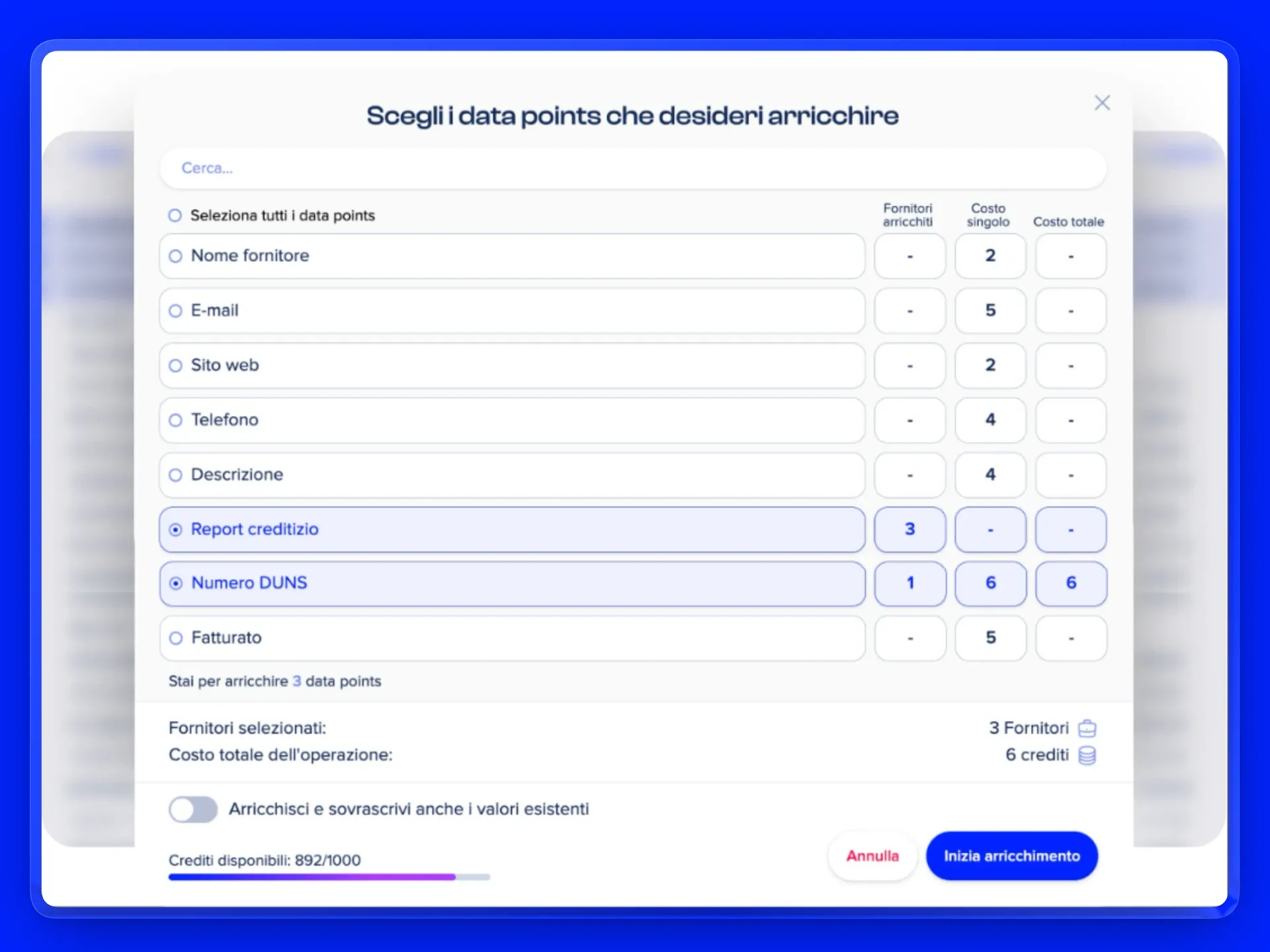
DataHub View
Through the DataHub feature, users can enrich supplier profiles in a single click with information such as:
* Certifications
* Updated contact details
* Credit reports
* DUNS number
* ESG certifications
This transforms the supplier database into a strategic asset from the very first sourcing phase.
2. Identify New Suppliers in Days Instead of Weeks
The integrated AI can analyze the market in real time and identify alternative suppliers across any category. Users can search using natural language and tap into Soource’s proprietary database to find exactly what they need.
Search results are then filtered based on selection criteria, providing precise and relevant supplier options.
3. Accelerate and Automate RFIs and RFQs
Soource automatically drafts RFX templates, sends bulk requests to suppliers, and uses AI to analyze responses, displaying them in intuitive comparison dashboards.
The AI manages the entire RFX outreach: from text creation to response classification. This dramatically reduces lead times and errors while increasing access to new suppliers.
Throughout the process, transparency is maintained, offering both price comparisons and performance positioning of each supplier.
What once took months can now be completed in a few days, freeing up resources for higher-value activities.
4. Reduce Risk and Dependency on a Limited Supplier Pool
In today’s environment, relying on a single supplier can jeopardize business continuity. Therefore, having a broad market view and a deep understanding of supplier capabilities becomes a strategic asset for the entire organization.
With predictive monitoring and constant updates, Soource supports dual sourcing strategies, risk reduction, and operational continuity.
Every search updates the database with detailed, verified data, enabling new collaborations, improved negotiations, and greater supply chain resilience.
The Seven Stages of Strategic Sourcing
While strategic sourcing strategies vary by company and need, the following seven stages represent the most commonly applied steps.
1. Spend and Needs Analysis
Mapping of consumption, contracts, and categories to understand internal demand and organize it based on specific characteristics.
2. Market and Risk Analysis
Study of current suppliers, new players, sector regulations, and geopolitical risks. A solid, verified supplier database is the foundation for expansion into new and innovative sourcing opportunities.
3. Supplier Segmentation
Classification of suppliers based on value, criticality, risk, and strategic relevance. Segmentation ensures data reliability and sourcing precision.
4. Sourcing Strategy Definition
From partnerships to dual sourcing, nearshoring, tenders, and supplier development: defining a strategy allows procurement to operate in a structured and testable way.
5. Supplier Evaluation and Negotiation
Assessment based on quality, price, capacity, compliance, ESG criteria, and performance history. With solid data from earlier phases, procurement teams can make well-informed decisions.
6. Contract Implementation and Onboarding
Formalization of the relationship, shared KPIs, and clear objectives mark the beginning of the collaboration.
7. Ongoing Monitoring and Strategic Review
Even after sourcing is complete, a strategic approach must continue: audits, risk analysis, and data updates help maintain the benefits over time.
How to Implement Strategic Sourcing in the Organization
Once the operational phases of strategic sourcing are defined, integration within structured teams requires careful planning. These steps facilitate the transition:
1. Set Clear Objectives
Whether aiming for cost reduction, resilience, diversification, or sustainability, the entire team must be aligned on priorities.
2. Invest in Data and Technology
Reliable and current data is essential. Adopting solutions like Soource provides access to verified information for better decision-making.
3. Review Internal Processes
Ensure alignment among procurement, supply chain, quality, and finance departments to achieve a broader business impact.
4. Train the Team
Digital skills, data analysis, and AI literacy are essential to keep up with technological changes. Tools with intuitive interfaces ease adoption and boost productivity.
5. Continuously Monitor Progress
Initial objectives must be measurable and time-bound. Regular KPI monitoring is a core component of strategic procurement.
Strategic sourcing is not just a methodology: it is a mindset focused on value creation, risk reduction, and digital transformation. Companies that integrate data, AI, and structured processes will gain a significant competitive advantage.
Procurement teams can become a driving force for innovation, delivering tangible and lasting benefits across the organization.
If you're curious to see Soource in action, book a demo and discover how it can help your procurement department adopt strategic sourcing strategies.
Book a demo



FAQ
We have collected the most frequently asked questions here, but don't hesitate to contact us if you have any doubts or want to know more about Soource.
Is Soource compatible with my ERP (Enterprise Resource Planning or Procurement Suite)?
Yes, Soource is compatible with major ERP and procurement software like SAP Ariba, Jaggaer and other enterprise systems. You can integrate it for bidirectional data exchange or use it as a plug & play solution, without the need for integration.
Are my data on Soource protected and secure?
Absolutely. All corporate, personal and supplier data remains your property and is processed according to GDPR and European regulations. Generic data is anonymized to improve platform and Soource community performance.
Where does supplier data on Soource come from?
Soource's database combines:
- Certified and public sources
- Data collected from intelligent web crawling
- Information automatically extracted from corporate emails
Today Soource offers the largest database of Italian companies with direct email contact.
Can I attach files to RFI, RFQ or RFP on Soource?
Yes, you can attach documents in any format to your requests (RFI - Request for Information, RFQ - Request for Quotation or RFP - Request for Proposal). In particular, for RFIs, it is recommended to include a technical specification sheet of the product to get more detailed responses from suppliers.
Can I send follow-ups to suppliers with Soource?
Yes. With Soource you can filter suppliers who haven't responded and send a mass follow-up in one click. This helps you double the response rate, up to 80% on average, improving RFI, RFP and RFQ management.
Is Soource compliant with the European AI Act?
Yes. Soource's artificial intelligence is compliant with the European Union's new AI Act, falling into the zero-risk category, as it only supports internal activities and does not automate outward processes or critical decisions.
Why use Soource for RFI and RFP?
With Soource you can:
- Create RFI (Request for Information) and RFP (Request for Proposal) in just a few clicks
- Send them automatically to selected suppliers
- Analyze responses with artificial intelligence
- Extract and compare certifications, availability, technical capabilities
You save time and identify the best suppliers more quickly.
Can I also use Soource for RFQ?
Yes. Soource also supports RFQ (Request for Quotation) to request economic offers. The platform automates:
- RFQ sending
- Response reception and reading
- Comparison of prices and conditions